02
Industrial Automation & Controls
Programming, controls and instrumentation handled as one scope instead of three vendors, in manufacturing plants and health care facilities that cannot stop for wiring.
Chapter 01
Controls, programming and instrumentation as one scope.
Industrial automation, programming, instrumentation and controls are four different lines in a capability list, and on most jobs they are one scope handled by one shop rather than four separate vendors handing a project back and forth.
That matters because each piece depends on the others. A control panel is only as good as the programming behind it, and the programming is only as good as the instrumentation feeding it real data. Splitting that across vendors is where the finger-pointing starts when something doesn't work.
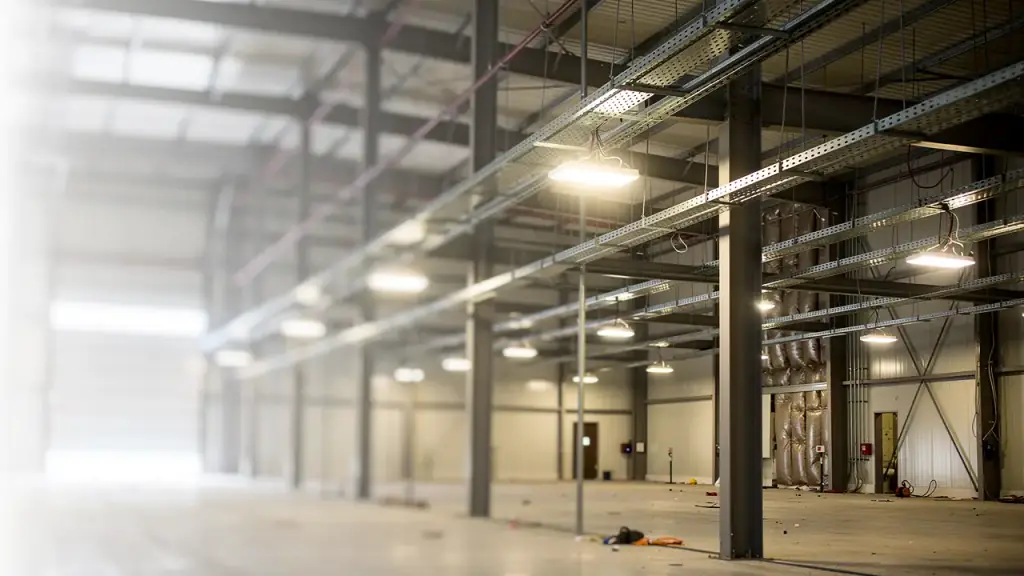
Interior of a steel-frame commercial building at electrical fit-out stage, cable tray and conduit running the length of the deck
Manufacturing plants do not stop for wiring.
Manufacturing is a named capability here, and manufacturing work has a rule that construction work usually doesn't: the line still has to run. That means phased cutovers instead of one big shutdown, and it often means the work happens on a weekend or during a planned shutdown window instead of a Tuesday afternoon.
Tagging what's been changed and getting the line back to production cleanly is as much a part of the job as the wiring itself. A plant that loses a shift because a cutover ran long has lost more than the electrical work cost.
Chapter 03
Instrumentation: the loop is the deliverable.
A transmitter reading pressure, temperature or flow is only useful if the signal gets where it's going clean. That means signal wiring kept separate from power, routed and supported the way instrumentation is supposed to be, not run alongside a feeder because it was convenient.
A loop check, confirming the signal at the transmitter matches what shows up at the control system, is part of the work, not an extra step. So is documenting it. A loop nobody wrote down is a loop somebody has to re-trace the next time it acts up.
Health care facilities carry their own rules.
Health care facilities are a named capability here, and they don't get treated like a commercial building with more paperwork. Essential branches and isolation requirements change how a circuit gets designed and how it gets tested, because in a hospital or clinic, power going down isn't just an inconvenience.
Testing here isn't a formality either. It's part of what makes a facility's electrical system something the building can actually rely on when it matters.
Lone Star Electric — Local and state licensed. Insured and bonded. Call 817-335-8044.