What Actually Goes Wrong in a Commercial Service Entrance
The service entrance is the one part of a building nobody thinks about until something downstream stops working right.
September 4, 2026 · 4 min read
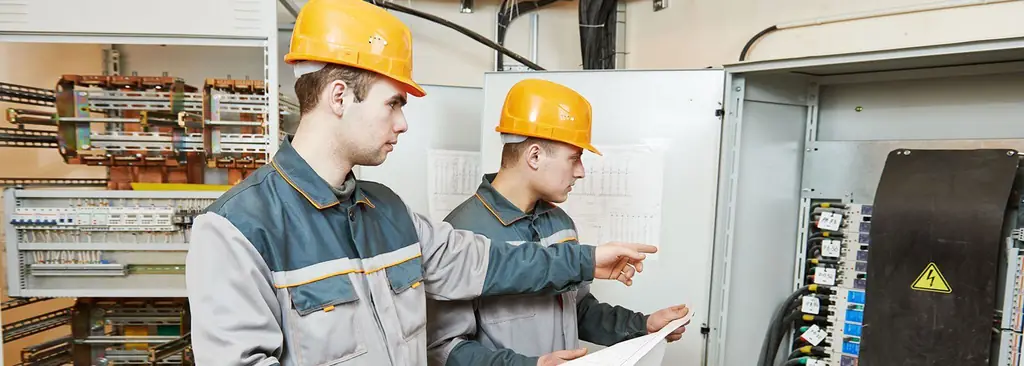
Ask a building owner where their power comes from and most can point at the meter. Ask what happens between the utility conductor and the first breaker in the building and the answer gets vague fast. That gap is where a lot of commercial electrical trouble actually starts. The service entrance is the point where utility power becomes the building's power: the conductors, the main disconnect, the metering equipment, and the gear that steps everything down into the panelboards that feed the rest of the structure. It is not glamorous work, but it is the work that decides whether everything downstream behaves the way it is supposed to.
Where the building's power actually stops being simple
A service entrance is a chain: utility conductors, main switchgear or switchboard, metering, then feeders out to distribution panelboards on each floor or in each area. Every link in that chain has to be sized for the load it is actually going to carry, not the load someone guessed at when the building went up. We do a load calculation before we touch anything, because undersized feeders and overloaded panelboards are the single most common root cause we find behind problems that look like they belong somewhere else entirely.
The symptom rarely lives where the fault does
This is the part that surprises people. A breaker trips on the third floor and the instinct is to look at the third floor. Sometimes that is right. Just as often, the real cause is a loose lug at the service entrance, a bonding connection that has loosened over years of thermal cycling, or a feeder that was sized for a building with half the equipment load it carries today. Nuisance tripping, flickering that moves around the building, and equipment that runs hot for no obvious reason are all classic downstream symptoms of an upstream problem. Chasing the symptom instead of the source wastes time and money, and it tends to come back.
Medium and high voltage is a different day, not just a bigger job
Some of the commercial and industrial buildings we work on step down from medium or high voltage before power ever reaches a panelboard a tenant would recognize. That work carries its own clearances, its own switching sequence, and its own protective equipment for the crew doing it. It is not low voltage work done at a bigger scale. Anyone opening medium or high voltage gear needs to know exactly what state it is in before a cover comes off, and that discipline does not change because the schedule is tight.
Grounding is the part nobody sees and everybody depends on
Bonding and grounding rarely make anyone's list of visible problems, because when they are done right, nothing about them is visible. Ground rings, equipment grounding conductors, and bonding jumpers are what let the protective devices in the building actually do their job during a fault. A breaker sized correctly and installed correctly can still fail to clear a fault fast enough if the grounding path behind it is compromised. We check this as part of any service entrance work, not as an afterthought.
What we need from you before we quote
- Any existing panel schedules or one-line diagrams you have, even old ones
- Your utility account information for the service in question
- Access windows if any part of the work needs the building's power interrupted
That's the short list. It is enough for us to scope the visit properly and tell you what we're actually looking at before we start opening equipment.
Estimating and design-build both start at the same point
Estimating and design-build are both part of what we do, and for service entrance work they usually start from the same place: an honest look at what's there now against what the building actually needs to carry. A quote built off a real load calculation and an actual inspection of the existing gear holds up. A quote built off square footage and a guess doesn't, and it tends to show up as a change order later once someone opens the equipment and finds out what's really behind the cover. We'd rather tell you what we're looking at up front, even when that means the scope grows before work starts, than have that conversation halfway through the job.
Lone Star Electric has been doing this kind of work in Fort Worth and across the Dallas Metroplex since 1970. Fifty six years is long enough to have seen most of the ways a service entrance can go wrong, and long enough to know that the fix almost always starts with tracing the problem back to where it actually lives, not where it happens to show up. We hold Texas Master Electrician License #4993 and Texas Contractors License #17204. If something in your building is acting up and you suspect it traces back further than the panel in front of you, call us at 817-335-8044, Monday through Friday, 7:00 am to 4:30 pm.
Lone Star Electric — 817-335-8044
Call 817-335-8044More articles
Backup Generators and UPS: What Each One Actually Covers
A UPS and a generator solve two different problems, and the gap between them is where most standby power plans fall apart.
Planning an Electrical Fit-Out Without Holding Up the Other Trades
The electrical scope on a fit-out is rarely the bottleneck when it's planned right, and almost always the bottleneck when it isn't.